

A Magyar Narancs article

Diet diaries on the internet – “I did not learn this”
Enthusiastic amateurs, self-taught athletes and new mothers are the lay fitness stars of our time, thanks to the internet connecting the masses aspiring for a better physique. Others are content to strengthen their own willpower with their diet diaries, of which there are thousands on the internet.
"More and more often, people call me a personal trainer or an expert, but this term applies to me just as much as calling dentists or psychologists doctors. It's ridiculous and amusing. I simply write down what I know, in a way that everyone understands. I formulate directly and strongly, but these remarks are needed to make the content striking and to make many people pay attention to it," says Bence Benedek, who has been writing his blog, named LifeT!lt, since January, about diet, exercise, and generally the benefits of lifestyle change. He has no qualification in dietetics or sports; he is employed full-time by a telecommunications company, and he originally started writing his online diary hoping that it would help him complete his previously abandoned workout program. His readers first witnessed him losing nearly 15 kilograms, and then came the continuation: he began to get people into shape who were selected from applicants encouraged by his success. First, a young woman who was extremely dissatisfied with her appearance gained a new look before the virtual audience's eyes, then he helped a man who had gained a lot of weight to lose 20 kilograms...
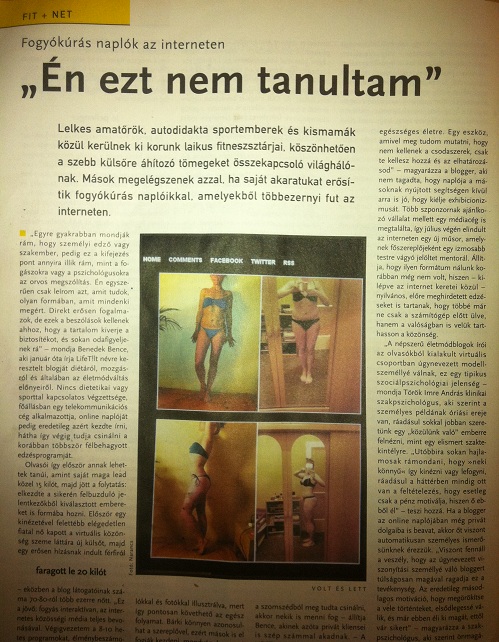
- meanwhile, the number of blog visitors grew from 70-80 to several thousands. "This is the future: interactive weight loss, with the full involvement of internet social media. I guide people through 8-10 week programs, illustrated with experience reports and photos, so that the entire process can be accurately followed. Anyone can easily identify with the participant, so others will start too, saying that if the girl next door could do it, then they can too," says Bence, who now also has a good number of private clients. "LifeT!lt educates people for a healthy life without self-interest. It's a tool with which I can show that miracle cures are not needed; only you and your determination are needed," explains the blogger, who did not deny that his diary, in addition to helping others, is also good for satisfying his exhibitionism. In addition to several companies offering sponsorship, a media company also found him, and so at the end of July, a new show was launched on the internet, in which he mentors a candidate who desires a more muscular body. He claims that such a format has not existed in Hungary before, as - stepping beyond the boundaries of the internet - they also hold public, pre-advertised training sessions, so that the audience can join them not only in front of the computer but also in reality.
"The authors of popular lifestyle blogs become so-called model personalities in the virtual group formed by readers; this is a typical social psychological phenomenon," says Imre András Török, clinical psychologist, who believes that personal example has immense power, and moreover, we prefer to look up to someone "from among us" rather than an acknowledged authority. "Many people are prone to say about the latter that 'it's easy for him' to look or lose weight like that, and besides, there is always the assumption in the background that perhaps only money motivates him, since he lives from this," he adds. If the blogger even shares private matters in his online diary, then we automatically feel him to be a personal acquaintance. "However, there is a danger that the blogger, who becomes the so-called reference person, gets too carried away by this activity. The originally secondary motivation to record what happened to him becomes primary, and he expresses himself through this, expecting success from it," explains the clinical psychologist, who believes that the mere fact that someone reaches hundreds or even thousands of people can cause narcissistic distortions in their personality and transform their self-image.
"This is a huge industry, so many people try to get close to it," states Attila Katus, aerobic coach and lifestyle consultant. "Fitness-wellness is currently a bit like football; everyone understands it, everyone comments on it."
It's possible that someone who reads up on it and writes a blog about it knows more than average, but this knowledge is usually not deep enough," claims the six-time aerobic world champion, then adds: "A sports background doesn't hurt, because someone who has never done it is unlikely to be suitable to advise others. This is an interdisciplinary knowledge; you need to understand many things from anatomy to psychology to nutrition science, and for this, several years, even decades, of practical experience are beneficial for it all to come together." According to Katus, copying a workout plan read online can also be dangerous. "If you don't succeed in losing weight, the failure of a lifestyle program by someone perceived as an expert can demotivate and set you back," says the aerobic coach.

Dr. Gyula Pados, chief physician and senior consultant for the lipidology profile at Saint Imre Hospital, also believes in diets based on modern nutritional principles, carried out with the involvement of specialists. He did not wish to comment on methods published by laypersons on the internet, but noted that weight loss can only be achieved by reducing calorie intake. "In my opinion, there are four pillars to obesity treatment: diet, lifestyle change, exercise, and medication. The only thing debatable is the nutrient composition within this, as for twenty years a low-fat diet was advocated, but now studies have confirmed that a diet low in fast-absorbing carbohydrates and high in protein and fiber is better," he says. According to the chief physician, with the popular miracle diets spreading online today, weight loss is mostly temporary. "The best results can be expected with medical and dietary help, as it is difficult to stick to a diet for more than six months without appetite-suppressing medication," says Pados.
At the same time, online weight loss diaries can be - psychological - crutches during weight loss - whether we write them ourselves or follow others'. "It's a factor that increases willpower if we diet in the public eye of the web, because if we fail, humiliation occurs before a community," explains Imre András Török, who believes that this type of support is also important because fundamentally psychological reasons play a role in the growing scale of obesity. "It is a scientifically proven mass phenomenon that eating has become a substitute gratification; its function is no longer survival, but stress reduction and pleasure seeking," he says. The online audience has an effect called social facilitation in social psychology. "It's like having a constant cheering section. And if negative feedback comes, it can also motivate us to 'I'll show them'," adds the clinical psychologist researching the behavioral patterns of online users.  Judging by the increasing number of weight loss diaries, many rely on virtual encouragement. On the hoxa.hu portal, mostly visited by women, a total of 13,000 people record what happens to them; within this, in addition to "baby" and "world affairs" memoirs, there are currently more than 3,000 specific diet diaries. The community portal, which has more than 80,000 unique visitors daily, operates a "weighing" service: a graph can track how everyone's body weight changes. "There's a magic to the formation of the group, to others commenting on posts and witnessing the transformation throughout," says Gyöngyi Farkasné T., the founder of the portal. In a good case, many people give up sooner; some after 4-5 posts, others stop writing after a few months.
Noémi Zólyomi-Zsirkai started writing her transformation story on this portal, then continued it on her own blog, where she reported for over a year on how she lost 38 kilograms after giving birth. Every single day, she accurately recorded what and how much she ate, how many calories it contained, and what exercises she performed. "I not only wrote meal plans but also experimented with new recipes. I enjoy doing it because it's a huge success when I get feedback that others have lost 5-10 or even 30 kilograms by reading my posts," says the new mother, who originally started at 98 kilograms. "I told everyone that I could only share my own experiences because I never learned this." Her lifestyle blog - which is currently on hiatus due to the arrival of her second child - was regularly read by nearly two thousand people daily, and she hopes that the number of visitors will continue to increase when she gets "back in top shape" after childbirth. Since then, she has also organized her own weight loss competition, for which nearly 120 people applied. The media also noticed the new mother-blogger on maternity leave: she appeared in several magazines with her weight loss story, impressive before-and-after photos, a TV channel made several programs about her, and recently she was invited as a speaker to a professional open day. However, she also experienced the expected downsides of public exposure. "I got both good and bad feedback. Many accused me of contacting the media myself, but they simply found me. But even before the appearances, I was criticized for blogging. By opening myself up to the world, I have to accept that not everyone can like me. Only this is sometimes difficult, especially when not only I, but also my family, even my child, are attacked," says Noémi Zólyomi-Zsirkai.
"Starting a blog is very easy these days, but standing out and grabbing the attention of the critical mass can only be achieved with truly good content. And there's still too little of that; more people want to lose weight than can write well about it," states Mihály Csótó, leading researcher at the Information Society and Trend Research Center (ITTK), who has also been running his own running blog for years. "Fitness is inherently a popular topic, attracting even those who just read for entertainment. There's no recipe for what makes such a site popular, but honesty can really engage people," explains the researcher, who also warns that caution is advisable. "It's important to have source criticism when searching online, not to believe everything, but to be able to evaluate and even cross-check information from other sources. As he says, it turned out that the young lesbian Muslim woman - who was referred to as an icon of the Syrian uprising based on her blog - was actually a forty-something white American man who posted his revolutionary entries from a university dorm room." Yet, the essence of diet blogs is credibility, which is not easy to maintain if advertisers appear on a frequently clicked page. "As soon as business enters, readers may become uncertain whether the blogger still wants to help and motivate, or rather just earn money."
Zsófia Gergely
I wouldn't add anything. I'll write my opinion about this article sometime because I wanted to try what it feels like to write a post drunk anyway.
