

300 Spartan Training
The Canadian Fast Motion stunt community and the Gym Jones Team have become one of the most professional and sought-after stunt and fitness teams in American filmmaking. Their breakthrough came with the film "300," when they signed a contract with Warner Bros. to physically and mentally prepare the cast. Gym Jones became known for its unique training methods and marine mental preparation exercises in the early 2000s. The Fast Motion company, mostly composed of French members, has since gained incredible recognition and popularity, despite being primarily French, and as we know, it would be difficult to find bigger asshole sandpits than the French on Earth. The physical preparation of the actors and stuntmen was led by Mark Twight, who also prepared Daniel Craig (James Bond) and Jake Gyllenhaal (Prince of Persia). Several members of the Fast Motion and Gym Jones Team also appeared in the film.
An instructive compilation. As you read it, think about what these people do to achieve their goals, how much they give up, and how you should do a fraction of that to live a normal, human, healthy life. The article is by Mark Twight, which you can find the original here.
The Warner Bros. press kit reads: "To prepare for battle, training emphasized athleticism using complex movements, lifts, and throws. Primitive tools—medicine balls, kettlebells, rings—were used instead of machines. Every training session was competitive with a punishment-reward system, and results were posted daily for all to see."
This type of training is completely normal for us, but others found both the work and our language unusual. Gerry Butler recounted: "The first time in my life I was called fat was when I got this role." Many outsiders were upset by the "punishment" aspect, or by the fact that one of the tasks designed for it was called "Redemption of Losers." Someone asked, "You call people losers? That's not nice!" My answer is that we're not here to make friends; we had a job to do and we did it.
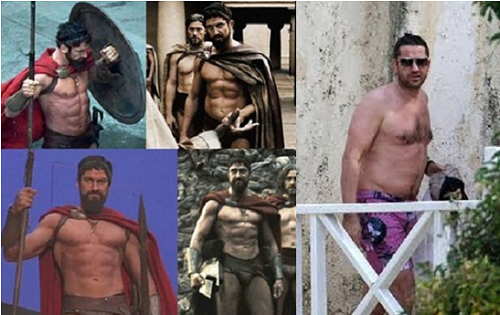
The typical inquirer wants to know about the magic workouts the cast did to look so good. Most were disappointed to hear that hard work is the magic; while others were amazed—indeed, sometimes even we were—that actors were willing to work so hard. The first misconception is that we used a bodybuilding program based on progressively increasing weights and overfeeding to make the subjects look huge. We went the opposite way: we introduced calorie restriction to make people look like they lived a wild, natural life, and were "sinewy" and lean.
Nutrition was sufficient for effort and recovery—just barely. Physical challenges were assigned randomly and varied, so that they were never in an "equilibrium" state; to ensure they never knew what to expect; to elicit a stress response; to break them down; to make them fail in front of each other, which ultimately led to trust forming between them. This trust was needed for them to push themselves to the limit in each other's company, because that's what the film is about—risking everything. Since the fight training, conditioning, and eating all happened in one facility—practically the same room—the actors and stuntmen did everything under each other's scrutinizing eyes. Breaking the diet was also obvious; "tributes" were paid for outstanding performances; and general admiration was expressed when a very complex choreography was performed flawlessly.
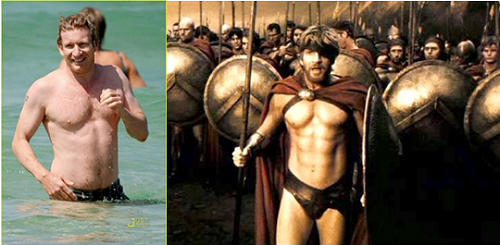
Our approach and attitude, the movements and activities, were new to many. Some, of course, resisted, while others enthusiastically embraced the method. Our goal—as defined by director Zack Snyder—was to mold them into a team, a unified force whose mutual trust would emanate from the screen. The first step in any such project is to earn the respect and trust of the trained subjects. Zack helped by "loading the cannons," meaning he trained with us 3-5 times a week. On such days, when the actors and stuntmen arrived at 8:30 AM, Zack's performance for the day was already visible on the board. The knowledge that he too had gotten up and already earned his calories for the day motivated them to strive for greater effort. "Some get up, others roll over..."
The group of actors and stuntmen had to be fit and athletic enough to endure the fight training and choreography learning, which was supervised by Damon Caro and Chad Stahelski. To achieve our goals, we embraced the following credo: looks are a consequence of fitness. This ideal guided our work. My assistant, Logan Hood, and I were simultaneously team builders, corruptors, trainers, and disciplinarians. We led by example, and apart from a few overuse injuries (since we were in the gym 10-12 hours a day, 5 days a week for 4 months), our fitness, along with that of our subjects, continued to improve. In an interview, Butler summarized his experience: "Almost anything Mark Twight served up was so hard you wished you'd never been born—in fact, so hard you wished he'd never been born."
To ensure the guys could last the entire project, we emphasized regeneration alongside hard work: a masseur was on-site every day, and a kinesiologist came twice a week to treat any complaints. Our work also had the side effect of keeping the stuntmen healthy: "It was a huge help in terms of injury prevention, endurance, and general concentration," says Caro. "With fight choreographies, there's only a limited amount of time for physical training because it often doesn't fit with functional application. But what Mark brought to the project was functional strength, not just peaked biceps and six-pack abs."
Functional means that fitness matches the task, and "artificial" training was highly transferable. Our methods were appropriate for the task. In our work, the goal determines the method. The method was sometimes brutal: if someone strayed from the right path on the weekend, we crushed them in the gym on Monday. And the pressure polished the rough material into a diamond, as is evident on screen. The other misconception is how often the "Spartan training program," also known as the "300," was used and who completed it. The "300" was an occasional test, only offered by invitation to those we deemed ready. By the end of the four-month project, 17 people completed this workout (Logan and I were among them). This was about half the team. We supervised every test, meticulously scored every repetition, and only counted those that met our expectations for form and range of motion. Like any workout, the "300" isn't difficult once you've done it, but the fear that builds up before it (and this is something we encouraged) reached such a level in some people that it hindered performance. This complex workout was a trial by fire that some completed, while others are still standing at the threshold.
"300"
25 pull-ups
50 deadlifts at 60 kg
50 push-ups
50 box jumps (60 cm)
50 "windshield wipers" on the floor holding a 60 kg bar
50 Kettlebell (16 kg) clean and press (touch floor between reps)
25 pull-ups
-----------------
300 total repetitions
As for daily regular training, there was no constant, structured workout program. Moreover, we hardly ever repeated a workout during the four-month journey. The goal was to increase fitness and abilities in the three-dimensional range of motion required for fights and in all types of movement. We achieved this by constantly varying challenges and focusing on athleticism to create a balanced general physical capacity foundation.
Butler remarked that my idea of training is: "Go until you're worried for your life, then go further. Then do more." He also made the connection between the physical and psychological aspects when he said: "This was also preparation for King Leonidas' mental state. The Spartans were trained to be the best, and why should we be shy about being the best? We, the Spartans, are so aware of who we are that an outsider can never understand it." I think that, in essence, we formulated and wrote the program for this task in the same way: the physical difficulties prepared the mind for the role.
Did it work? Yes, for those who did the work; who paid attention; and who controlled what they put in their mouths. We strengthened those who started with their own self-discipline, but we cannot instill discipline in those who lack it from the outset. By the end, Vincent Regan lost 18 kilos in 8 weeks, and his initial deadlift of less than his body weight increased to twice his body weight. He could also move 85% of his maximum blindfolded, and even in the midst of the toughest workouts, he could perform Shakespeare.
Andrew Pleavin only trained with us for 5 weeks, but his pull-up count increased from six to 23; he rowed 500 meters in 1:25, 5000 meters in 18:12; and completed the "300" test in 18:11. Similar changes occurred among the stuntmen, and their work capacity increased in most cases. Even those who arrived relatively fit improved their fitness, as we uncovered and addressed their weaknesses. This whole experience was incredible, something I don't think could ever be repeated. From the writers to the director, from the actors to the stuntmen, it would be difficult to reassemble a team that is so talented, dedicated to their craft, and willing to work incredibly long hours when needed.
I am glad I could influence them and give an ideal to the young stuntmen. And I learned as much as I taught. Yes, this is the film industry, things are based on appearances here, but the energy and effort behind it are human, and in this case, these people were very good people! .
That's all. I won't be home this weekend, but on Monday, my last 32 days of weights, running, modified conditioning workouts begin, and if I see correctly, mountain bike training is also starting soon. Tonight, there will be a shorter post about my running workout, then we start on Monday. I've already shared it on Facebook, but damn it, you only get an ass like that once a year. The best thing I did this year, I think, was filming this girl at Oktogon. Even if my girlfriend broke up with me because of it, since such things happened to me in the meantime. It's also likely that the ambulance sirens were for her.
