

The Doping Baron
There's incredible professionalism and a technical team behind LifeTilt. For example, I can't write the successfully announced butt-sculpting post right now because my computer is in for service and all the photos and other materials about the girls are on that machine, so you'll have to wait for the butt-sculpting girls. By the way, I don't usually frequent IT circles, but damn, the way they all look like a bunch of stick insects is quite terrifying...
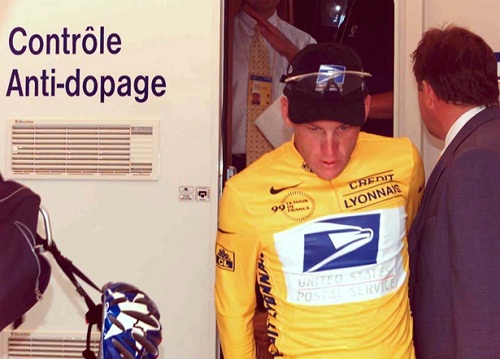
I never really wanted to publish this post because it aims to dismantle idols and tarnish people who are role models for millions of growing generations, from whom children can draw strength and who inspire them to start moving, to start exercising. I already expressed my opinion on this topic on the radio once, but unfortunately, Neo Fm stopped showing signs of life in the meantime. The topic will be doping, which has become an integral part of the sports world. Billions of dollars are at stake in professional sports, such as money from TV broadcasts, sponsorship money, and billions from sports equipment manufacturers and TV companies, who, in exchange for their money, must not only perform superhuman feats week after week but also produce marketable stars, world records, and performances that defy the laws of physics. Bolt, Phelps, Armstrong, Contador, Messi, Nadal, Bryant, Gretzky, to name just the biggest. According to experts close to sports, clean sports have been dead for 40 years, and what we have now is nothing more than gene manipulation broadcast on sports channels, and medical teams competing in laboratories.
It would be a big mistake, however, to believe that doping agents are worth anything on their own. Only truly pure idiots believe that the athletes we see on TV every day and read about online are where they are because they have EPO for breakfast and a rapid blood plasma infusion in their butts while watching TV. Doping, like nutritional supplements, is worthless on its own, just as no one in the world of bodybuilding became muscular simply by injecting steroids into their stupid head and then going to the sauna afterward. Doping accounts for 3% of the performance seen on TV, but true success and results can only be achieved by the remaining 97%. Daily 4-5 hours of training, mental strength, endless struggle, and the will to win to the extreme. These are things that rotten assholes will never understand. They will always believe that Schumacher became a 7-time world champion because of his car, that Phelps' 17 gold medals and Armstrong's 7 Tour de France victories are the result of a cocktail developed in a lab.
I am 100% sure that every elite athlete, after a certain level, resorts to doping, because you cannot cycle 4,000 kilometers in 3 weeks living on bread and water, you cannot play more than ninety competitive matches a year, running 10-12 kilometers per match at pace, and you cannot produce unimaginable performances for many years, constantly setting world records. Nevertheless, these people are gods and true heroes, because they mobilize millions and inspire them to a life filled with sports, incidentally generating billions, establishing foundations, and wherever they appear, they leave behind development and inspiration due to the overwhelming effect of their performance and charismatic personality.
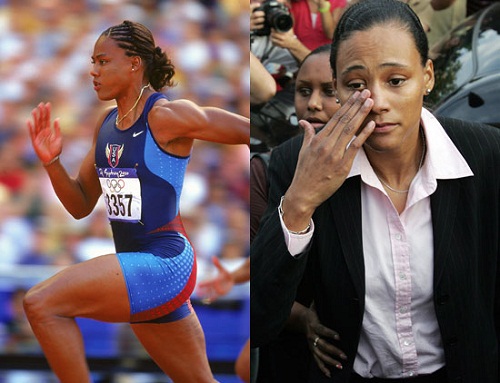
The rest of the post is a conversation with Angel Heredia, who, alongside Dr. Fuentes, was one of the most influential figures in manipulated sports, and who was casually known as the "doping baron" by the world press. Heredia was for years the unknown, yet connected, "non-existent" figure of American elite sports, and as it later turned out, the number one helper of 4-time Olympic champion Marion Jones. After his arrest, Heredia was forced into a plea bargain by the F.B.I. in 2006, meaning he either talks and tells what he knows, or he finds himself within the walls of San Quentin State Prison in California for decades, surrounded by some seriously pissed off, aggressively black, and socially inept, somewhat bisexual, cruel criminals. Heredia talked and told everything. The following part is a summary of that testimony, which was published by the German magazine Spiegel in 2008...
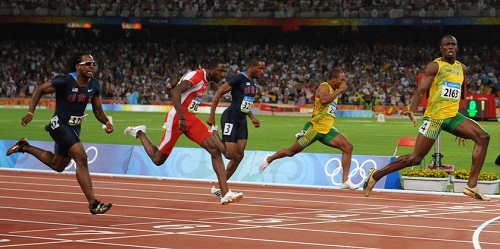
Spiegel: Mr. Heredia, will you watch the 100-meter final in Beijing?
Heredia: Of course. But we won't see a clean Olympic champion. Not even a clean participant.
S: Out of eight runners...
H: ... eight are doping.
S: But that cannot be proven.
H: Undoubtedly so. The difference between 10.0 and 9.7 seconds is the substance.
S: Can anyone become a world record holder with drugs?
H: No, that's a misconception: "You take something quickly today and tomorrow you'll soar." In real life, you have to train incredibly hard and be very talented, and you also need a team of professional coaches and assistants. And then the difference will depend on the best drugs. The whole thing is a great work of art, a symphony. You see, everything is connected, and the effects of the drugs are long-term: they ensure you regenerate, and avoid catabolic phases. Beach volleyball might be healthy - but elite sport is not. You destroy your body. For example, Marion Jones...
S: ... five-time medalist in Sydney in 2000 ...
H: ... trained incredibly hard. The drugs protected her from injuries. Then she won and collected the medals.
S: Are you proud of it?
H: Of course, still. It's a huge achievement, and don't think that Marion's rivals were poor dupes.
S: Are we not talking about an American problem?
H: What? No. Every country, every federation, every elite athlete is involved, and the responsible parties include the big shoe manufacturers, Nike and Adidas. I know athletes who ran world records and were injured a year later, when the call came: "We're cutting your stipend by 50%." What do you think these athletes do?
S: Tell me what you did for your clients.
H: Athletes hear rumors and worry. That their rivals have other tricks, that they might get caught when they travel. There's no room for error; even a single mistake can ruin careers.
S: So you became the athletes' helper in drug matters?
H: More like their coach. Together we figured out what was good for each body and what the breakdown time was. I put together cocktail and treatment plans, depending on how much the athlete offered. For little money, I gave street drugs, and serious stuff for a few tens of thousands. I mostly sent these by mail, but sometimes the athlete came to me.
S: In Marion Jones' case ...
H: ... it was about rest periods. In 2000, she competed one after another, she needed to relax. She received EPO, growth hormone, adrenaline injections, insulin. After training, insulin, together with protein drinks, helps: insulin helps proteins and minerals cross the cell membrane faster.
S: Jones was afraid of injections.
H: Yes, that's why her then-husband C. J. Hunter and her coach Trevor Graham mixed three substances into a single injection. I didn't recommend it to her; I considered it too risky.
S: What was your relationship with your athletes like?
H: Business. It was about values, dosages. I rarely spoke to Marion. We handled it through the coach.
S: Was there a kind of doping rhythm?
H: Yes, when the season ended in October, we waited a few weeks for the body to clear itself. Then in November, we gave growth hormone and EPO and examined the body twice a week to ensure no blood clots formed. Added to this were testosterone boosts. This first program lasted eight to ten weeks, followed by a break.
S: And then they set the goals for the season?
H: Yes, it depended on the athlete. Some wanted to run a good time in April to secure their contracts for major events, some only had the trials in mind, the American trials before international competitions, others only the Olympics. Then we prepared the schedule for the goal and the next cycle began. I had to know my athletes well and know which federation used which methods to test.
S: How do you know such things?
H: Vigilance. Informants.
S: You were once considered a good discus thrower yourself.
H: Good in Mexico, average globally. I played football, boxed, did karate, and then moved on to athletics. At 13, 14, I still believed in the purity of sport, I considered doping a sin; I even once asked my father if I could take an aspirin.
S: Why did you start doping?
H: For the same reason every other athlete does: because others are doping too. The guys I had recently beaten suddenly started throwing ten meters further. Then I got injured, but I still wanted to make the Olympic team. Doping became for me what it is for most athletes: part of the sport. If you train 12 hours today and your coach orders another 12-hour training tomorrow, you will dope, otherwise it won't work.
S: What did you take?
H: Growth hormone. Testosterone.
S: And still you missed the Olympics.
H: Yes, but I read everything I could find on the subject, talked to other athletes, and soon it spread: Angel knows about it, Angel knows how to beat the tests. They started asking for advice. That's how it started, and then sometime my coach Trevor Graham asked me if I could help him. I explained EPO to him, and I was in business.
S: How did you become the dealer for the world's best athletes?
H: My father is a chemistry professor, I love chemistry. And I was an athlete. My role became an obsession, for example, I learned everything about testosterone: that there's a type of testosterone with a long half-life and another that acts quickly, that it can be rubbed in, taken orally, injected. It was exciting: I could work with the best of the best and make them even better.
S: And how did you become the best in your own profession?
H: With precision. An example? Everyone talks about EPO. EPO is trendy. But EPO without iron intake is only half as effective, and you need to know things like that. There are oxygen-carrying substances that accelerate EPO, in fact, they're even better than EPO alone. I call my substance "Epo Boost," an EPO multiplier, I inject it, and it releases many small oxygen molecules throughout the body. This can multiply the effect of EPO tenfold.
S: Do you have other secrets?
H: Of course. There are kidney tablets that block steroid metabolites: when athletes then give urine samples, they don't excrete metabolites with it, and their test will be negative. Or there's an enzyme that slowly devours proteins - EPO consists of protein structures, so the enzyme ensures that the doping test B sample has a completely different result than the A sample did. Then there are also compounds that, if taken a few hours before the competition, prevent muscle acidification. And with EPO? They work wonders! I still have 20 substances that investigators cannot detect.
S: Which coaches did you work with?
H: Mostly Trevor Graham.
S: Graham received a life ban; he helped Marion Jones, Tim Montgomery, Justin Gatlin, and many other athletes cheat. Who else did you work with?
H: Winthrop Graham, his cousin. John Smith, Maurice Greene's coach. Raymond Stewart from Jamaica. Dennis Mitchell ...
S: ... who won gold in the 4 X 100 in 1992 and is now a coach. How did the collaboration work?
H: It's a different world. They talk about who can get what, when, and for how much, who is discreet. Coaches contacted me and asked if I could help, and I said yes. Then I received money, about $15,000, the first delivery was made, and thus the business was established. This then evolved into a one-on-one collaboration with the athletes over time.
S: So, once again: continuous world-class performance without doping is unimaginable?
H: Yes, it is. 44 seconds for 400 meters? Unimaginable. A 71-meter discus throw? Impossible. It's possible for someone to run a 9.8 in the 100 meters once with a tailwind. But ten times under 10 within a year, whether it's raining or hot? Only with doping.
"If you say he was clean, all I can say is that's a lie."
S: Testosterone, growth hormone, EPO, was that your combination?
H: Yes, in customized variations. And then wonderful things can come out of it. Jerome Young was only 38th in the 400-meter world rankings in 2002, then we started working together and in 2003 he won almost every major competition.
S: How did they pay?
H: I had an annual fee. For big successes, there was also a $40,000 bonus.
S: Your athletes won 26 Olympic medals. How much did you earn?
H: I cannot disclose that due to the investigation. Let's just say 16-18 successful athletes annually and $15-20,000 per athlete. I was in good shape, I lived well.
S: Didn't you live on the shadowy side of sports, where no one could see you?
H: No, although I rarely went to major events, this had more to do with jealousy: the Americans didn't want me to work with the Jamaicans and vice versa. Is this the shadowy side? No. The whole thing is a chain, from athletes to agents to sponsors, of which I was a part, but everyone knew the rules of the game. Everyone wanted it because everyone got rich that way.
S: What kind of agents are you thinking of?
H: The big intermediaries, like Robert Wagner, who work with athletes and want to get them into top shape because they place them at events.
S: Maurice Greene? The 100-meter superstar is an emblematic figure of the Olympic movement; he swears he's clean.
H: An investigation is underway, but if he claims he was clean, all I can say is that's a lie.
S: More specifically?
H: I helped him. I made a plan for him. I supplied him.
S: Supplied him?
H: Yes, we worked together in 2003 and 2004.
S: Do you have proof?
H: Yes, for example, a $10,000 transfer.
S: Greene says he spent the money on friends.
H: I know better.
S: Greene, who denies doping, what did he get from you?
H: IGF-1 and IGF-2, EPO and ATP, short for adenosine triphosphate, which strengthens muscle contractions.
S: Inspectors cannot detect it?
H: Undetectable. We also used creams that leave no trace and provide the athlete with continuously elevated testosterone levels.
Q: Is doping present in sports at all levels?
H: Yes, the only difference is in the quality of doping. The poor take simple steroids and hope they won't be checked. If you're among the stars, you earn $50,000 a month, plus appearance fees and shoe contracts. If you're among the best and invest $100,000, I'll create an undetectable special substance for you.
_1.jpg)
Q: Please explain that.
H: Special substances consist of several compounds that induce the desired reaction, then at the end of the chain, I alter one or two molecules so that the entire structure slips past the investigators' checks.
Q: And as investigators hunt down athletes...
H: ...that's also a kind of sport. A race. Pure adrenaline. We have to be one or two years ahead of them. We need to know which drug is being researched or used in animals where, and how we can get it. And we also need to know the methods of the inspectors.
Q: Can inspectors ever win this race?
H: Theoretically, yes. If all federations, sponsors, managers, athletes, and coaches agree and all money from sports is spent on this, and if every athlete is tested twice a week - but only then. What's happening now is ridiculous. An alibi. This money should be collected - give it to me and I'll distribute it among the Mexican orphans! As long as there is commercially driven sport, performance-based shoe contracts, and television contracts, there will be doping.
