

The Éva Risztov Story
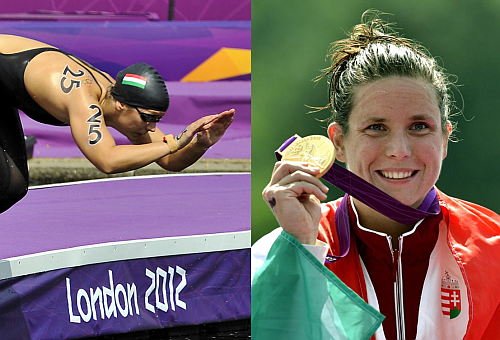
1 hour, 57 minutes, 18 seconds. That's all it took for a person's life to change radically, and for an athlete, written off and failed in the eyes of much of the profession, to become a shining star. And of course, now her biggest critics want to get close to her, claiming they knew it all along, that they had said so, but of course, they knew nothing. Éva's story is the story of life. A story about perseverance, will, and human qualities in an environment where almost no one believes in you anymore, where vows no longer matter, and big words interest no one. You just do it and move forward because you have no other choice; if you fail, it's over for you. It's just you and your dreams, just you and the goal you set for yourself, and of course, the sneering faces of the hyenas who gleefully watch your failure, whom you must show that they cannot win, they can never win.
"In London, a guy bet 1,000 pounds on me. Unbelievable. They paid 34 times the money for my victory, and he still believed in me..." There are things that cannot be conveyed in writing because you have to be there and feel them to grasp the weight of the words, so that when they form sentences, they convey their true message to us. No one had believed in Éva for a while, which is why this bet meant so much to her—that a stranger believed in her and bet on her victory. Éva is not interested in the current fuss, the suddenly appearing long-lost friends, the many "heartfelt," but mostly feigned congratulations, which I completely understand. For Éva, only those who were by her side before her gold medal matter; everything else is an unpleasant side effect, the false approaches of parasitic opportunists. People who let go of her hand years ago, and now trip over each other to shake it. My meeting with Éva and the time I spent with her once again made me realize many things... Risztov's story is now a happy ending in everyone's eyes, an extraordinary deed by a fantastic person, the Olympic championship title, and all the fuss surrounding her now, because wherever we went, whatever we did, Éva was surrounded by immense love, and everyone was proud of her and what she achieved. But it wasn't always like this...
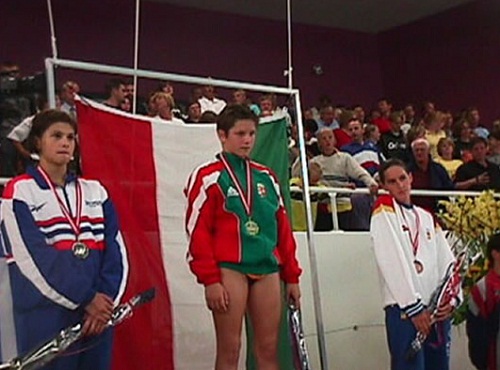
The story began in '98 when Éva, at 13, won her first Hungarian championship medal. A year later, as a 6-time Hungarian champion, she was clearly seen as the future, and expectations were increasingly set accordingly. Her talent was unquestionable, and her results were impeccable, but one thing was consistently overlooked, and this led to one of the greatest talents in Hungarian women's swimming announcing her retirement at just 20 years old in 2005...
From 2001, she became a competitor for Spartacus Budapest, and by then, it was implicitly understood that the future rested on this 16-year-old girl. The Egerszegi era had ended five years prior, Czene, one of the last from the golden age, had already finished in Atlanta, and in Sydney, only Ági Kovács was still keeping Hungarian swimming alive. The 2004 Athens Olympic gold was clearly expected from Risztov, and why wouldn't it be, as she had won almost everything in junior and short-course events before. Her results gave cause for optimism, and in her first major competition in the senior field, at the 2002 European Championships in Berlin, she won four silver medals, which Risztov experienced as a clear failure. To this day, the image of her on the podium, breaking into bitter sobs after receiving her fourth silver medal, is memorable. After this, Risztov went on a frantic rampage, sometimes blaming the aging German winner who, in her opinion, used impermissible means and improved inexplicably, and sometimes blaming herself. For Éva, only first place was an acceptable result; she didn't want silver, and every self-respecting athlete thinks this way, there's nothing surprising about it.
2003 was the year of the first major setback in Éva's career. She started training harder than ever before, and expectations for the Barcelona World Championships were higher than ever, a burden Risztov found increasingly difficult to bear. She began to push herself to an insane degree, adding extra training sessions beyond the daily 5-6 hours. She craved success more than anything else and nothing else mattered. In Barcelona, she won 3 silver medals, one of them in the 400m individual medley with a European Championship record. Risztov's true downfall began at this World Championship, and she was simply unable to process 7 consecutive second-place finishes. The final blow came with the complete failure at the Athens Olympics and the Montreal World Championships.
Towards the end of her career, every quiver, every gesture of hers betrayed that she considered it a tremendous injustice, an unfairness from fate, the world, swimming, and her immediate surroundings alike, that she hadn't reached greater heights. Professionals, however, adamantly claimed that she not only gave her maximum but even more. Indeed, one didn't need to be a master coach to notice that if Risztov's regular conquerors, Jana Klochkova or Otylia Jędrzejczak, were placed next to her, the physical differences were so striking in favor of her rivals that they could only be offset for a time by fanaticism, insane work, and a desire for success that perhaps exceeded what was healthy. Risztov became a victim of the unrealistic expectations others and she herself placed upon her, and after a desperate 4-month period, she literally fled from the world of sports and, I think, a little bit from herself as well.
It's a cruel thing when your dreams, for which you've worked so hard, don't come true despite all your efforts. In my opinion, three things can totally destroy a person: unrequited love, an unfulfilled longing, and when something you love doing most in life is taken from you or you throw it away yourself. Risztov found her way, but at that time, in that state, she was unable to fight further and, temporarily, gave up the struggle. Afterward, she began a desperate search, dabbling in motor racing, water polo, women's football, then wanting to be a lifeguard and work with children, but all this was just a substitute activity because it wasn't her path, and she felt that too. She felt she still had a purpose but wasn't ready to return yet.
.jpg)
Then, in 2006, she found love and completely subordinated herself to her relationship. She owes her return to this person, because if it weren't for him, Risztov wouldn't be an Olympic champion today. This relationship couldn't work for certain reasons that I won't go into now, but suffice it to say that the other person consciously exited the relationship after 3 years solely so that Risztov could embark on one last major preparation and compete in the London Olympics. In the spring of 2009, Risztov, weighing 93 kilograms, began her 2-and-a-half-year preparation to fulfill her big dream of becoming an Olympic champion. In 5 months, she lost 28 kilograms, and with daily 7-8 hour training sessions, she began to write her story, which we read in London in 2012.
Éva's story should be an example for everyone to follow and a reminder that we must never, ever give up on our dreams. There will be times when we can't achieve them the first time, or the second, or even the twentieth, but success might be in the next attempt. As long as we believe in it, as long as we trust ourselves, and as long as we truly do everything for success, there's no power that can stop us. If we give up, we give up on our dreams. If we give up on our dreams, we become aimlessly wandering nobodies, every minute closer to the conscious death caused by indifference. Performance doesn't start with running 2-3 or even 5 kilometers, nor is it a performance if you can go 2 damn weeks without sweets. That's nothing, that's trivial syrupy nonsense, non-existent achievements in a pathetic world. But just as the idea is not universal, performance cannot be examined uniformly. You have to prove yourself individually, relative to yourself and your abilities, and primarily to yourself, because performance begins where you feel you can't go on and collapse from pain. As long as you stop at that point and don't go further, you are a weak-willed nobody, and you haven't achieved anything, and in all likelihood, you never will, because you know, if you stop on the running track, you will stop in life too, and people standing still, not moving anywhere, have never achieved anything in life.
Éva Risztov is an Olympic champion and I believe she can be a personal hero for every Hungarian, whose performance and life story should give strength to all of us. Never stop, never give up on your dreams, and one day you will be someone's role model, and the news will be about you, and the press will be full of you.
Source: mno, wikipedia, Éva Risztov
