

Wasabi The Sushi Misconception

Four months ago I wrote a post titled Budapestaurant.com, in which I examined the twenty best-known and highest-turnover online restaurants from the perspective of where it's worthwhile, or even possible, to order food when you're on a program and dieting. Online restaurants have become an unavoidable part of our daily lives, because we now order food to our workplaces, when we hang out with friends, when we invite a girl over, and indeed my mother, with a poker face, ordered 8 servings of creamy chicken breast strips with mixed garnish for my father's birthday, calling it a festive lunch. Of course, the ordered food most often falls into the category of a well-packed, sizable pile of crap, because they can't bake enough pizza in Budapest or order enough sugar to not run out in an instant, and we're only talking about pizzas and desserts here. In Budapest, as I've written before, with the exception of a couple of downtown districts, it's impossible to eat normally, and I don't even dare to describe the conditions in Csepel, Soroksár, or Pesterzsébet, not that Pasarét or Zugló would be any better. A minimal shift can perhaps be observed in the direction that now, in addition to goulash-sauce-covered slop mountains, a grilled chicken breast fillet can be found in a well-hidden corner in most places, but just to be safe, they also melt some cheese on it, because otherwise no one would buy it, right? I've already touched on this in previous parts of Budapestaurant.com, so now let's get back to online restaurants, and let's start with one of the biggest misconceptions...
SUSHI RESTAURANTS ARE NOT DIET-FRIENDLY PLACES; in fact, they are almost on the same floor as the best-known fast-food chains when it comes to calorie and unnecessary fat intake. I know that for some people, a world is crumbling right now, and I haven't even mentioned Nordsee yet, but I don't want to shock anyone with such a large dose all at once. Of course, you're probably thinking about vegetables, tofu, and fish, and that I should just go to hell, but the fact remains that those who regularly visit sushi restaurants will eventually look like Schmuck Andor. Following this path, let's take a closer look at the flagship of sushi restaurants, Wasabi...

A few months ago, Wasabi released a separate menu titled Health & Happiness, which is a bit of a hint that their "normal" menu isn't exactly the carefree Philadelphia that the general public might imagine. Within the Health & Happiness section, everything goes, except for Wakai. On the regular menu, the soups are also good, as are the makis, a few main courses, and 3-5 pieces of sushi can easily be incorporated into a strict diet, so that part is fine, but that's where the sunny feeling ends, because what comes next is quite dreadful. Let's dive right into the deep end and clarify something. As with all "all you can eat" places, where you can eat as much as you want for a certain price, there are dishes with such compositions and calorie counts that you're guaranteed not to be able to eat enough for it not to be profitable for the restaurant. Everyone's been to a running sushi. There, the food goes around on a conveyor belt on plates, and you take whatever you want. During such a session, you can easily down 3-5000 calories, because if you've already paid 5,490, you're going to eat, but you don't necessarily have to eat a lot to reach that calorie count. I don't know who has been to a company event or party where unlimited alcohol was available. Usually, at such times, you keep drinking even when they're cleaning your stomach with a tube. This reflex kicks in at these places too, only here you're paying for it. My friend Ákos and I once bet that we would eat 50 plates during such a meal. Ákos lasted until 27, I asked for the bucket at 48. Trophy is the same, only there they are even bigger bastards, because before you eat anything, they put a pizza in front of you. Huge.
Sushi restaurants are dangerous, because a salmon cream sushi itself is only 101 kcal, a tiger shrimp nigiri is 113, while a red tuna nigiri is 61 kcal, which is not a problem at all, but the problems start when these are combined to make complete sushi platters that constitute a full portion. These portions are delivered to homes in 8, 12, 16, and 24-piece packages when ordered. Add up the 100-120 calorie foods, multiply by just the smallest portion, which is 8, and we're already there, having spit in our own faces with enthusiasm, and these were only the low-calorie, more diet-friendly portions I listed. This is how the Botan platter becomes 660 calories, the Shite 1,021, and the Hetima 744 kcal. The biggest trap is that you think you're eating healthy and diet-friendly foods, because what else would it be if it's fish and salad? Wasabi is one of those restaurants that lists the calorie value next to each of their dishes, which is a big plus for the place, but I doubt that even 20% of the people eating there even look at these values. Let's start with sushi, which exists on its own but is basically served in a selection. Tuna, salmon, maki, avocado, arugula, crab, egg, cucumber, tofu, all devilishly delicious foods. For comparison, a Big Mac sandwich at McDonald's is 495 kcal, a double cheeseburger McRoyal is 775 kcal.
I have a female friend who recently shared a picture on Facebook, the essence of which was that a guy brought her lunch at work, which was nothing less than a tray of food from Wasabi. The guy wants to pick up the girl now, and there's nothing wrong with that, we've done more for a woman, but that's not the point now.
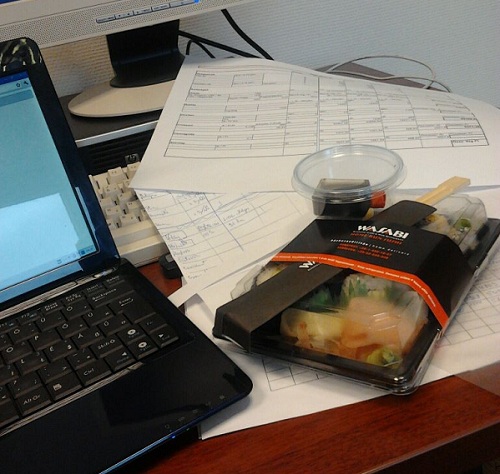
The girl is currently on a diet, as women often are, but the main point is, if I see correctly, this is a 12-piece meal, which is easily 1000 calories. A dieting woman's average daily calorie requirement is 1,200-1,400 kcal, and with this care package, the guy beautifully sabotaged the girl's efforts.
What comes next is hard to put into words, because so far we've only been talking about sushi, salmon, crab, squid and tuna, mussels, maki, all foods that are truly healthy and good in human quantities. However, the Wasabi menu also contains a respectable amount of pasta, main courses swimming in sauces, side dishes, desserts, oily breaded appetizers, and you can even order a salad that alone contains 561 kcal (wakame).
Calorie Problem
I cannot stress enough that 100 calories are not equal to 100 calories. The given calorie count is only a guideline for the amount of energy in the food, but only the composition of that energy matters. That's why these Gastroyal meals are such a huge scam. They give small portions, which indeed result in a reduced calorie count and weight loss, but the proportion of quality ingredients in that food is guaranteed to be terrible, which means you will never be toned and will not achieve a beautiful appearance, because all the crap you put into yourself will not shape you. You can't build a castle out of crap, right? Let me give you an example to make you understand what I'm talking about. There's a 130-kilo woman whose daily calorie requirement is 3,500 calories. If this 130-kilo woman eats nothing but 2 bars of Milka chocolate a day, which contain 1,300 calories, then due to the calorie deficit, she will indeed lose weight, even up to 30 kilos, but I'd like to see that body and body composition after the second week. She will have a flabby, rotten, craptastic body with sagging skin, a disgusting, deformed body, because eating little of bad food is not a solution. This is the biggest scam in these "diet" menus that offer small portions of crap. This is dangerous because the illusion that you will lose weight is there, but it will come at a high price later on, and it provides a perfect breeding ground for the pounds to come rushing back. So we don't just count calories, but we also look at what the calorie content of the given food is made up of, and what proportion of healthy ingredients it contains. I hope I've explained it clearly, and everyone understands that this is one of the foundations of successful and lasting weight loss, and this is exactly what distinguishes good diets from bad ones. I will write a separate post about this, but for now, let's go back to Honshu Island.

At Wasabi, there are no appetizers under 400 kcal, and as you already know, these are all unacceptable. The soups, as I mentioned, are fine, but the main courses have several flaws. Calories in the range of 600-700-800 are flying around, and there are serious problems with the preparation of the dishes, but there are exceptions here too, for example, the stir-fried vegetable tofu in a wok and the mushroom spinach tofu sound quite good, unlike the Thai flaming chicken, which in my opinion is not much different from the langos at Palatinus beach. The side dishes are quite clear. Rice, of course, is a basic food and can be eaten, although the whole portion shouldn't be forced, the spiced potato chips are obviously trash.
By touching on the "pasta" menu item, we have entered the land of hell. All the pasta available at Wasabi should be forgotten immediately, as there is no measurable difference between the dishes found here and the offerings of fast-food restaurants. The pasta truly shows the side of Wasabi that I already mentioned in the introduction. You look at the menu, you read "Glass noodles with chicken and vegetables," you think it's good because chicken and vegetables are there, the little bit of pasta doesn't count, right, and boom, damn it, 794 kcal. It's a common misconception that anything that includes the word "vegetable" is already good, but that's not true. Speaking of vegetables. Salads at Wasabi. Kids, Mixed salad 378 kcal!!!!!!! Green edamame beans 402 kcal, Wakame salad 551 kcal, and these are just the salads you eat with your main course. Oh, and the Bento boxes aren't good either.

Finally, a menu that people typically order from Wasabi for home, or sit down for an evening business dinner, a date, or some celebration. Everyone starts with sushi or maki, because, after all, we are at a Japanese place.
Appetizer: Crab maki 180 kcal
Soup: Miso soup 105 kcal
Main course: Ginger marinated chicken bites 538 kcal
Side dish: Rice 254 kcal
Salad: Mixed salad 378 kcal
Total Score: 1,455 kcal
I deliberately didn't include dessert, but if you order that too, it's at least an additional 350 kcal. If you order online and eat the Tokyo Tiramisu, that's another 941, and I haven't even counted the drink you'd have with it.
There's not much else to add. Except that I would ask the management of Wasabi not to sue me for this post.
Thank you.
